Exploring Elizabeth CO Horse Properties and Acreage
April 2, 2026
April 2, 2026
If you want elbow room, horse space, and a little more sky in your daily life, Elizabeth is one of the first places many buyers look. But acreage and horse properties near Elizabeth are not all the same, and the difference between a great fit and a costly surprise often comes down to zoning, infrastructure, and land management. If you are thinking about buying in this area, this guide will help you understand what to look for, what questions to ask, and how to narrow your search with more confidence. Let’s dive in.
Elizabeth sits in western Elbert County, about 45 miles southeast of Denver, which gives you a more rural setting while still keeping the metro within reach. According to the Town of Elizabeth, many properties with an Elizabeth mailing address are actually outside town limits.
That matters because an Elizabeth address can mean two very different things. You may be looking at an in-town parcel with tighter rules, or a rural property in unincorporated Elbert County where zoning, permits, and animal regulations work differently.
Before you fall in love with a barn, fenced pasture, or arena, make sure you know which jurisdiction controls the property. The Town of Elizabeth handles permits inside municipal limits, while Elbert County handles construction permits in unincorporated areas.
This is especially important in the acreage market because many of the properties buyers associate with “Elizabeth” are really county properties. If you plan to keep horses, add structures, or make improvements, that town-versus-county distinction should be one of your first due diligence steps.
In Elbert County, zoning helps explain where true acreage and horse properties tend to be found. The county’s dimensional standards table shows minimum lot sizes that range from 35 acres in A zoning to 20 acres in A-2, 10 acres in AR and RA, 5 acres in RA-1, 2.5 acres in RA-2, and much smaller sizes in more compact residential districts.
In practical terms, that means horse-oriented properties usually cluster in the rural districts, not in the tighter residential ones. If your goal is a property with room for animals, outbuildings, and flexibility, zoning is not a small detail. It is a major part of the search.
Elbert County also has specific animal rules by zoning district. According to the county FAQ, R-1 allows two equine but no cattle, sheep, or goats, while R-2 allows no large animals.
For RA, RA-2, RA-1, AR, and A-2, the county uses an animal-unit density of one unit per one-half acre, and one horse, mule, or bovine counts as one unit. The county also requires shelter at one animal unit and has rules covering manure removal, odor and noise control, and drainage so runoff does not affect neighboring properties.
If you are looking inside the Town of Elizabeth, horse keeping is more limited. The town’s disclosure form says one horse is allowed on parcels of at least 20,000 square feet, and more than one horse on less than 2 acres requires a Use by Special Review permit.
The same disclosure notes that horses or livestock in residential and PD zoning are generally nonconforming unless they existed on the property as of March 9, 2010. In short, if you want a straightforward horse setup, many buyers find the surrounding county properties offer more flexibility than in-town lots.
When you look at current and recent listing examples, a clear pattern shows up. Elizabeth-area horse properties are often marketed not just as open land, but as improved properties with the features buyers actually need for day-to-day use.
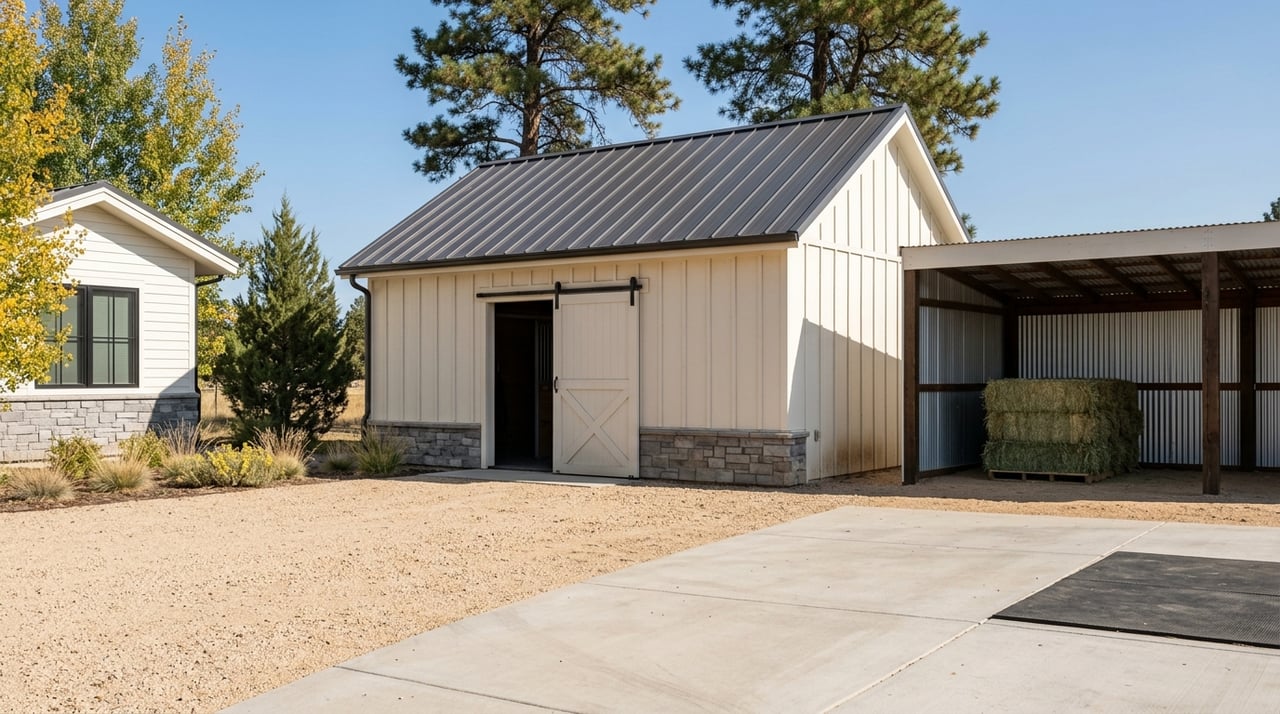
Recent examples include a 5-acre Elizabeth horse property with a 30x30 Morton barn, three run-ins, two large pastures, and an area previously used as an arena. Another nearby 5.01-acre Wild Pointe Ranch listing featured a large barn or RV garage, a three-stall barn, two paddocks, an outdoor riding arena, and community equestrian trails.
At the larger end, a 9.6-acre equestrian estate and larger ranch-style properties show what horse-ready can mean on a bigger scale, including multiple stalls, tack and wash areas, turnout spaces, hay storage, fenced pastures, and additional outbuildings.
Based on the zoning framework and the listing examples above, acreage near Elizabeth often falls into two broad categories:
That distinction can help you search smarter. If you mainly want personal horse space and some room to spread out, a smaller setup may fit. If you want more extensive turnout, livestock infrastructure, or ranch-style use, larger acreage may be the better match.
Acreage alone does not tell you whether a property is truly horse-ready. Two 5-acre parcels can feel very different depending on fencing, layout, drainage, shelter, and the condition of the improvements.
As you evaluate properties near Elizabeth, pay close attention to features like:
These are the features that show up repeatedly in local listings because they affect how usable the property is from day one. If a property has the land but not the setup, you will want to factor in the time, permits, and cost of adding improvements.
Many acreage properties near Elizabeth rely on private infrastructure, so it is important to verify how the property functions before you buy. Well and septic questions should be part of your early due diligence, not something you leave until the end.
Colorado’s Division of Water Resources provides well permit search tools that can help you confirm allowable uses and permit details. For septic systems, Elbert County Public Health requires OWTS permits before installing or repairing systems, and the county notes that OWTS with flows of 2,000 gallons per day or less are permitted locally through the county.
If you are buying a property with an existing barn, tack room, shed, or garage, or if you plan to build one, permit history matters. The town states that permits are typically required for structures over 120 square feet or for work involving electrical, plumbing, or mechanical systems.
That means you should not assume every outbuilding was added with the right approvals. A quick check on permits can help you avoid surprises after closing.
One of the biggest misconceptions in the horse property market is that a few acres automatically means easy horse keeping. In reality, small acreage requires active management.
Colorado State University Extension explains that small acreage pastures in Colorado are generally too small to serve as a major feed source and can be damaged by unlimited access. The guidance recommends short turnout periods, sacrifice areas, and rotational grazing.
CSU Extension also notes that an average horse produces about 5 cubic feet, or 350 pounds, of manure per week, which adds up to about 9 tons per year. That is a useful reminder that horse ownership is not just about space and views. It also means planning for daily care, footing conditions, pasture wear, and manure handling.
Acreage purchases usually involve more moving parts than a typical suburban home purchase. Asking the right questions early can help you avoid wasting time on properties that do not fit your goals.
Here are a few smart questions to keep in mind:
The more clearly you define your needs up front, the easier it becomes to separate a scenic property from a functional one.
If you are searching for acreage and horse properties near Elizabeth, it helps to start with your use case instead of just your price range. Think about whether you want a manageable hobby setup, a larger ranch-style property, or land with future improvement potential.
From there, you can narrow your search around zoning, infrastructure, and improvements rather than just the total number of acres. That approach usually leads to better choices and fewer surprises, especially in a market where two properties with the same mailing address may follow very different rules.
If you want practical guidance as you compare acreage, horse setups, and rural due diligence near Elizabeth, Mike Bomgaars is here to help you sort through the details and find a property that fits how you actually plan to live.
Mike Bomgaars is dedicated to helping you find the perfect home or sell for top value. With years of experience and a commitment to honest, hardworking service, he’s ready to guide you through every step of your real estate journey.